By Martin Mulligan
The Mexican corrido can be understood not only as a musical or narrative form, but also as a historical technology of memory. From its origins in the Spanish romance to its contemporary circulation through digital platforms, the genre has continuously transformed the mechanisms through which memory is preserved and transmitted. The history of the corrido can therefore be read as a tension between orality and archive: each new technology preserves something from the previous form while simultaneously changing the way stories are narrated, remembered, and circulated.
In its earliest manifestations, the corrido belonged primarily to the realm of oral culture. Descended from the Spanish romance and related popular forms such as the valona, jarabe, copla, and relación, it circulated among rural, mestizo, and largely non-literate populations. Its function was never exclusively musical. Corridos also transmitted news, narrated conflicts, recorded violence, and preserved events that rarely entered official archives. Álvaro Custodio described the corrido as a kind of poetic news sheet, capable of recounting the violent events of a historical period through simple melodies and a critical spirit. Pasted markdown
During the nineteenth century, this memorial function became particularly important. Civil wars, foreign invasions, border conflicts, armed bands, and outlaws provided the corrido with a constant narrative source. Songs recorded dates, names, places, executions, defeats, and heroic deeds. In this sense, the corrido functioned as a kind of primitive newspaper: a community archive that existed before much of its audience had regular access to literacy and print media. Pasted markdown
The fair and the cantina were two fundamental spaces for this oral memory. At regional celebrations, corridistas competed, improvised, and transmitted repertoires from one generation to another. The cantina, meanwhile, transformed the corrido into intimate dialogue, nostalgia, and the celebration of the valiente. Yet dependence on human memory also made this repertoire vulnerable to disappearance. The case of the corridista Juan Montes is revealing: much of his work vanished because the following generation simply failed to memorize his songs. Pasted markdown
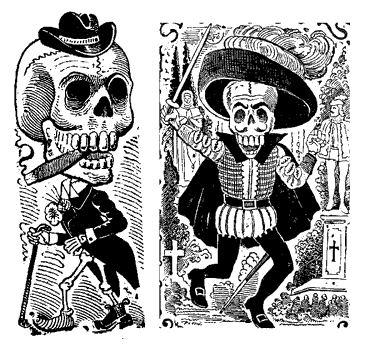
The arrival of print radically changed this system. During the Mexican Revolution, publishers such as Vanegas Arroyo, whose printed sheets were accompanied by illustrations by José Guadalupe Posada, transferred the corrido from collective memory onto paper. Orality began to coexist with a material archive. A corrido could now travel without depending entirely on the singer and could survive beyond the fragility of individual memory. Print expanded its circulation between countryside and city and became an important vehicle for cultural and ideological exchange. Pasted markdown
But every technology of preservation also produced transformation. The arrival of recorded music and radio during the twentieth century altered the corrido itself. In the recording studio, compositions that could once last twenty minutes had to be compressed into approximately three minutes to fit commercial formats. Traditional elements—including the opening salutation, precise locations and dates, and the farewell—were weakened or disappeared altogether. The new medium preserved the corrido while simultaneously reshaping it. Pasted markdown
The cassette later introduced another form of mobility. Norteño music traveled with Mexican migrants, circulated throughout communities in the United States, and eventually returned to Mexico. The corrido was no longer tied exclusively to a particular region. It became part of a transnational network of production, consumption, and memory. Pasted markdown
Los Angeles became crucial to this transformation. Informal markets, independent record companies, radio stations such as La Qué Buena, and performers such as Chalino Sánchez changed both the geography of the genre and the mechanisms through which it circulated. Corrido memory no longer depended upon a single local community; it became part of a cultural industry capable of connecting Culiacán, Los Angeles, and Mexican communities throughout the United States. Pasted markdown
At the beginning of the twenty-first century, YouTube opened yet another stage. If print had fixed the word and the record had fixed the voice, digital platforms could preserve sound, image, performance, and circulation simultaneously. The corrido increasingly became an audiovisual archive capable of moving almost instantaneously across territories and audiences.
The history of the corrido can therefore be understood as a succession of mutations in the technologies of memory. Orality created a mobile, communal memory; print materialized it; recording compressed it; the cassette made it transnational; radio industrialized it; and digital platforms transformed it into a global audiovisual archive.
The corrido has survived precisely because it has never remained attached to a single technology. Every new medium has altered its form, but each has also renewed its historical ability to remember from the margins.
Leave a Reply