

Martin Mulligan, PhD.
University of Missouri-Columbia
| *Presented at the Alcohol and Drugs History Society (ADHS) Biennial Conference in Paris, France, in the summer of 2026. |
This essay is about a drug, but not primarily about a drug. Rather, it is about a cultural transformation taking place within one of the longest-lasting narrative traditions in the Americas: the Mexican corrido.
For nearly a century, corridos—and later narcocorridos—told stories about the movement of illicit commodities across the U.S.-Mexico border. Their protagonists transported marijuana, heroin, cocaine, or methamphetamine. These were narratives of smuggling, pursuit, violence, and social mobility. Drug traffickers appeared as economic and military actors operating within a permanent state of conflict.
Between 2021 and 2025, however, a new generation of artists radically transformed that tradition. Performers such as Natanael Cano, Peso Pluma, Junior H, Luis R. Conriquez, Tito Double P, Gabito Ballesteros, Neton Vega, and Óscar Maydon shifted the narrative center of the genre.
The question is no longer what commodity is being moved. The question is how life is being lived. Drugs cease to function primarily as commodities. Instead, they become atmospheres. No substance illustrates this transformation more clearly than tusi.
To understand why a drug associated with luxury, nightlife, and exclusivity has acquired such symbolic prominence within contemporary corridos, it is necessary to step back and consider the longer history of the genre. The significance of tusi can only be understood in relation to the role corridos have historically played as vehicles of popular memory and social narration.
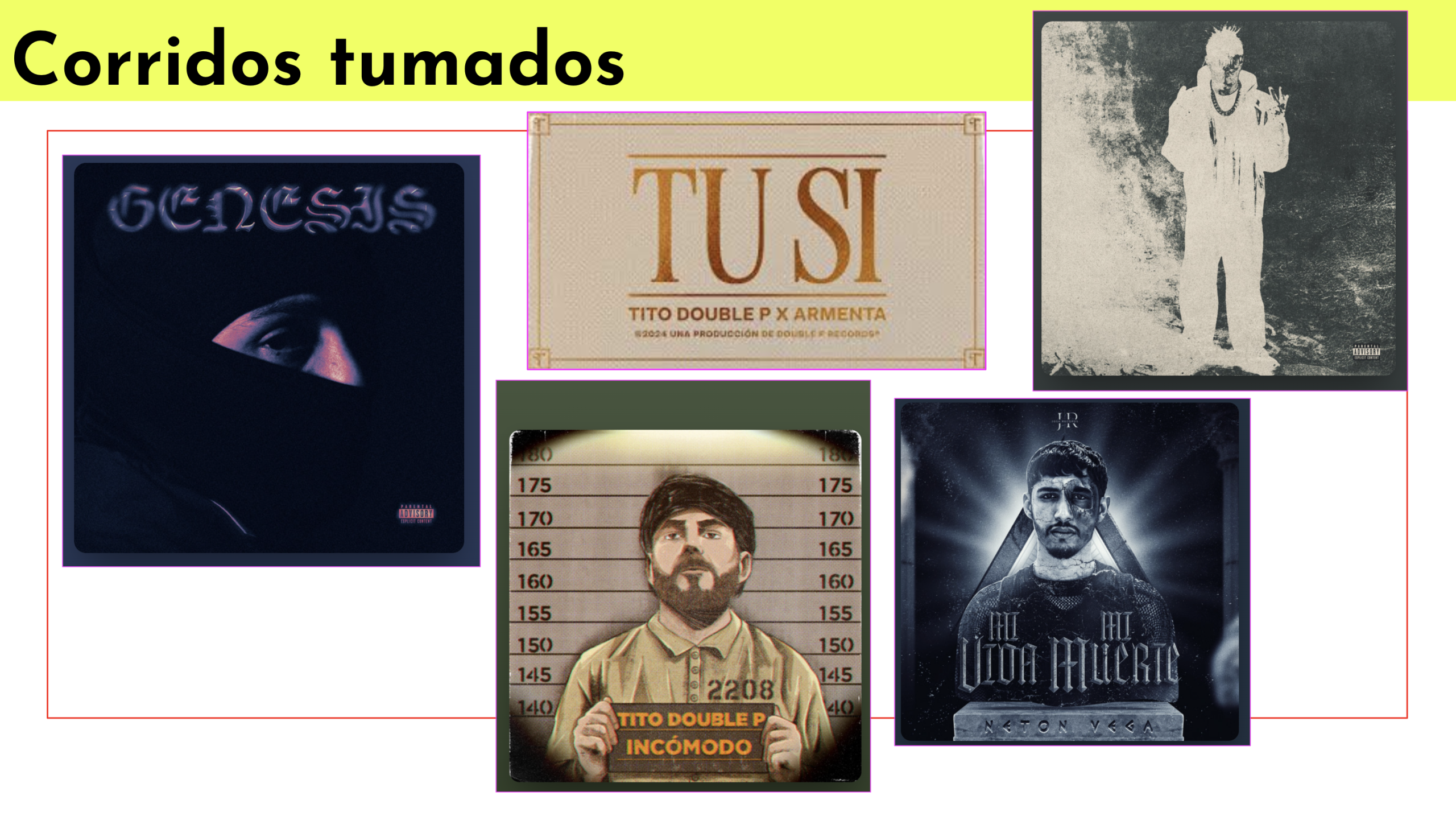
The Corrido: An Epic Form That Survived Modernity
Every culture has produced narrative songs. Ballads, romances, epic songs, and oral chronicles have long served as mechanisms for recording events and preserving collective memory.
Many of these traditions disappeared with modernity. The Mexican corrido did not.
On the contrary, it survived for more than a century and evolved into a powerful cultural industry whose principal centers of production are located between Los Angeles and Culiacán, Sinaloa.

Drawing on Aleida Assmann’s concept of cultural memory and Juan Carlos Ramírez-Pimienta’s understanding of the corrido as a popular narrative form, the corrido may be conceived as a vernacular archive of collective experience. Through stories of real and mythical figures, historical events, and social conflicts, corridos preserve and transmit memories that frequently remain outside official historical records. Their value lies not in their factual accuracy but in their capacity to represent how communities remember, interpret, and emotionally process their shared realities.
Throughout the twentieth century, this archival function became particularly visible in narcocorridos. These songs documented smuggling routes, conflicts between criminal organizations, and the transformation of transnational illicit economies.
The commodity stood at the center of the story. The drug was an economic object. The corrido narrated its movement. What mattered was the journey: who transported the commodity, how it crossed the border, what risks were involved, and what rewards awaited at the destination. Narrative attention focused on circulation.
For precisely that reason, the appearance of tusi in contemporary corridos is so revealing. Before examining its role within these songs, however, it is worth considering what tusi actually is. Not because its chemistry explains the phenomenon, but because the contrast between what tusi is and what it represents illuminates the cultural shift currently taking place.
What Is Tusi?

The term tusi derives phonetically from “2C-B,” a psychoactive substance synthesized in 1974 by the American chemist Alexander Shulgin. 2C-B belongs to the phenethylamine family and combines psychedelic, stimulant, and entactogenic properties. For decades, it remained relatively marginal within recreational drug markets.
Contemporary tusi, however, rarely contains 2C-B. Forensic analyses conducted across Latin America have identified mixtures containing varying combinations of ketamine, MDMA, caffeine, benzodiazepines, cocaine, food coloring, and other synthetic substances. In many cases, no trace of 2C-B is present at all.
This means that tusi functions less as a stable chemical substance than as a cultural category. What circulates is not merely a formula. What circulates is an idea. An imaginary. A promise of exclusivity. An aesthetic associated with nightlife, luxury, youth, and celebration.
This observation shifts attention away from chemistry and toward meaning. Tusi derives part of its value not from its pharmacological effects but from its symbolic associations.
That symbolic dimension is crucial for understanding its place within contemporary corridos. Tusi did not transform the genre on its own. Rather, it found a privileged position within a broader transformation already underway: the emergence of the corrido tumbado.
The Corrido Tumbado Revolution

Musically, the corrido tumbado emerged from an innovative fusion of the traditional sierreño style with instrumental elements associated with Sinaloan banda music, particularly brass arrangements featuring trombones and charchetas.
The emergence of corridos tumbados transformed regional Mexican music both sonically and narratively. Although a growing body of scholarship has begun to examine the genre—particularly its musical innovations, digital circulation, and cultural significance—much remains to be understood about the stories these songs tell and the transformations taking place within their narrative universe. This work contributes to that ongoing conversation by focusing on one of its most revealing figures: tusi.
In traditional narcocorridos, protagonists were crossing borders with shipments, evading law enforcement, or confronting rival organizations.
In corridos tumbados, those events largely occur offstage. We know the protagonists belong to criminal structures. We know they carry weapons. We know they operate within organized crime. We know they are capable of violence. Yet we rarely witness those activities directly. Instead, we encounter them elsewhere. On yachts.
In nightclubs. At afterparties. In luxury resorts. On private beaches. The war remains suspended. Consumption occupies the center of the narrative.
This shift is more profound than it initially appears. The criminal world that structured the narcocorrido has not disappeared. What has changed is the point of observation. The narrative no longer focuses on the illegal labor that generates wealth but on the lifestyles that wealth makes possible.
It is within this new narrative landscape that tusi acquires significance. The substance helps communicate a particular experience of prestige, exclusivity, and belonging. Consequently, it functions less as a commodity than as a symbol.
From Commodity to Symbol
Here we encounter the most striking aspect of tusi. Unlike cocaine, heroin, or marijuana in classic narcocorridos, tusi rarely appears as merchandise. It is not transported. It is not sold. It does not cross borders. It generates no visible profits. It simply exists. It forms part of the scenery.
In songs such as “Lady Gaga,” by Peso Pluma and Junior H, tusi appears alongside Dom Pérignon, luxury vehicles, influencers, designer brands, and international travel.
Its function is symbolic. Tusi communicates belonging. It communicates prestige. It communicates access. It does not describe an economic activity. It describes a lifestyle.
For this reason, it may be useful to think of tusi as an anticipatory drug. Regional Mexican music is constructing the emotional and aspirational imaginary of a substance whose symbolic circulation exceeds its actual market penetration.
In other words, corridos do not merely reflect an existing reality. They also help produce it. Yet the transformation extends beyond the symbolic status of the drug itself. More significant is the change experienced by the protagonists who consume it. If tusi has become a marker of identity rather than a commodity, the subject represented in these songs has also undergone a profound reconfiguration.
The Endriago Subject in Love

The figure that Sayak Valencia describes as the endriago subject remains present. These characters continue to participate in criminal economies. They remain armed.
They continue to exercise violence. They continue to accumulate capital and prestige. Yet they now display something that traditional narcocorridos rarely foregrounded. Vulnerability. Heartbreak. Abandonment. Emotional pain.
Songs such as “Pink Cake” and “Cholo” portray protagonists who consume alcohol, marijuana, cocaine, or tusi in an attempt to forget a woman who has left them.
In “Cholo,” the protagonist declares that he would rather have gone to prison than lose the woman he loves. The statement is remarkable. Prison—one of the classic destinies of the narcocorrido—appears less painful than romantic abandonment. Criminal epic becomes melodrama. The armed operator becomes a heartbroken lover. The hitman cries. The outlaw longs. The local boss makes late-night phone calls.
What we witness here is not merely the inclusion of romantic themes. Corridos have always contained stories of love. The novelty lies in the centrality of emotional vulnerability within characters historically defined by toughness, risk, and violent capacity.
Moreover, this sensibility appears repeatedly across the genre. It is not an isolated motif but a recurring narrative structure. That repetition invites a broader question about the emotional experience these songs are attempting to articulate.
In this sense, tusi may also be understood as the contemporary reactivation of an older cultural image within the corrido tradition. Its function recalls, in important ways, the place once occupied by tequila in corridos of banditry. During the Porfiriato, the cantina and the local fairs that spread across rural Mexico became privileged spaces of popular sociability, where the bandit descended from the sierra or emerged temporarily from his hideout to drink, celebrate, gamble, fall in love, and momentarily suspend the violence that structured his existence. Tequila acquired cultural agency within these narratives not simply as an intoxicant, but as a substance associated with masculine identity, emotional release, celebration, and temporary escape. Tusi appears to recover and transform this older narrative function. The setting has changed—from the cantina and the village fair to the nightclub, yacht, luxury resort, or afterparty—and so has the substance, but the narrative operation remains strikingly familiar: intoxication marks the interval between violence and vulnerability, between the armed subject and the emotional subject.
This historical continuity complicates any interpretation of tusi as an entirely new phenomenon. What is new is not necessarily the association between intoxication and the emotional life of the outlaw, but the aesthetic and generational form that this association now assumes. Tequila belonged to the world of the bandit, the cantina, and the rural fair; tusi belongs to the world of the young criminal operator, digital celebrity, luxury consumption, and permanent nightlife. In both cases, however, intoxication provides a narrative space in which the hardened masculine subject can temporarily become something else: nostalgic, wounded, celebratory, desirous, or vulnerable.
Trauma, Repetition, and Loss
At this point, Cathy Caruth’s work on trauma becomes particularly useful. Caruth argues that traumatic experience often returns through repetitive forms of narration. The event does not disappear. It returns. It insists. It repeats itself. Something similar occurs throughout many corridos tumbados. Romantic rupture returns again and again. The protagonists continue speaking to absent women. They remember them. They search for them. They imagine them. They transform them into the permanent addressees of the song. Violence is no longer exclusively external. It becomes emotional.
In this sense, many of these songs revolve around losses that cannot be fully resolved. The protagonists remain trapped in an ongoing dialogue with what is no longer present. The wound remains open, resurfacing through memories, accusations, fantasies of reconciliation, or forms of intoxication designed to produce temporary forgetting.
Yet this repetition is not only about romantic relationships. It also reveals a distinctive relationship to time itself. Beneath the recurring narratives of heartbreak emerges a broader generational condition characterized by difficulty imagining durable futures.
A Generation Without a Future

There is still another dimension to consider. The protagonists of these songs are young.
They possess weapons, trucks, watches, money, status, and romantic partners.
Yet they also seem trapped within a permanent celebration. As if the party never ends. As if the future itself has been suspended.
Constant partying, recreational drug use, and the relentless pursuit of pleasure can be interpreted as symptoms of a generation whose relationship to the future has been profoundly weakened.
Nothing is accumulated for tomorrow. Everything is consumed today. The narrative no longer describes a trajectory. It describes a continuous present. The songs do not orient themselves toward distant goals. What matters is the intensity of immediate experience.
Tusi thus becomes a technology of the instant. A substance designed to intensify the present moment.
Viewed from this perspective, tusi ceases to be merely a recreational drug. It becomes a privileged lens through which broader transformations in contemporary sensibility can be observed. Through it, we can trace changes in consumption, emotional life, and the ways a generation imagines—or struggles to imagine—its future.
Conclusion
The importance of tusi within corridos tumbados does not lie in its chemical composition. Nor does it lie in its actual presence within illicit markets. Its significance resides in what it allows us to see. Through tusi, we can observe how the Mexican corrido has partially abandoned the narrative of smuggling in order to enter an economy of affect.
We can observe how the commodity became a symbol. How war gave way to celebration. How the trafficker became a consumer. And how the endriago subject began to sing not only about power, but also about loss. Tusi is not the center of this story. Tusi is the symptom.
The real subject of this essay is the transformation of sensibility that the Mexican corrido has begun to register during the first half of the 2020s. And, as it has done for more than a century, the corrido once again finds itself narrating something that is still unfolding. Or perhaps something that has only just begun to arrive.
Leave a Reply